Online slots are designed to look mechanical. Reels spin, symbols slow down and a final combination lands on the screen. Underneath the animation, however, the game is software. The outcome is determined using a Random Number Generator, usually shortened to RNG.
Understanding the RNG clears up some of the most persistent slot myths. A game does not need to “make up” for a losing streak. Pressing Spin at a different moment does not create a reliable strategy. Increasing the bet does not force the game to release a bonus. The visible reels present an outcome produced by the game’s approved mathematical system.
This guide explains the process in plain language: how random values become reel positions, how randomness can coexist with a fixed RTP, what independent testing is intended to verify and what players can—and cannot—control.
Important: Understanding RNG technology does not make slot outcomes predictable or profitable. Slots retain a house edge and every session can end in a loss. Only gamble where legal and only with money you can afford to lose.
An RNG is a system that produces values designed to be unpredictable. In an online slot, those values are used to select an outcome from the possibilities defined by the game’s mathematical model.
Most software games use a pseudo-random number generator, or PRNG. “Pseudo” does not mean visibly fake or easy to predict. It means the sequence is created by an algorithm initialized from a seed or internal state rather than by a physical event such as drawing a ball from a machine.
A properly designed and tested software RNG should produce output that is statistically suitable for the game and computationally unpredictable without complete knowledge of its internal system.
The UK Gambling Commission’s remote technical standard for random outcomes requires RNG output and game results to be acceptably random for regulated games under its authority. Its guidance addresses distribution, unpredictability, seeding and scaling.
The exact implementation differs between developers, platforms and game types, but the general process can be understood in six stages.
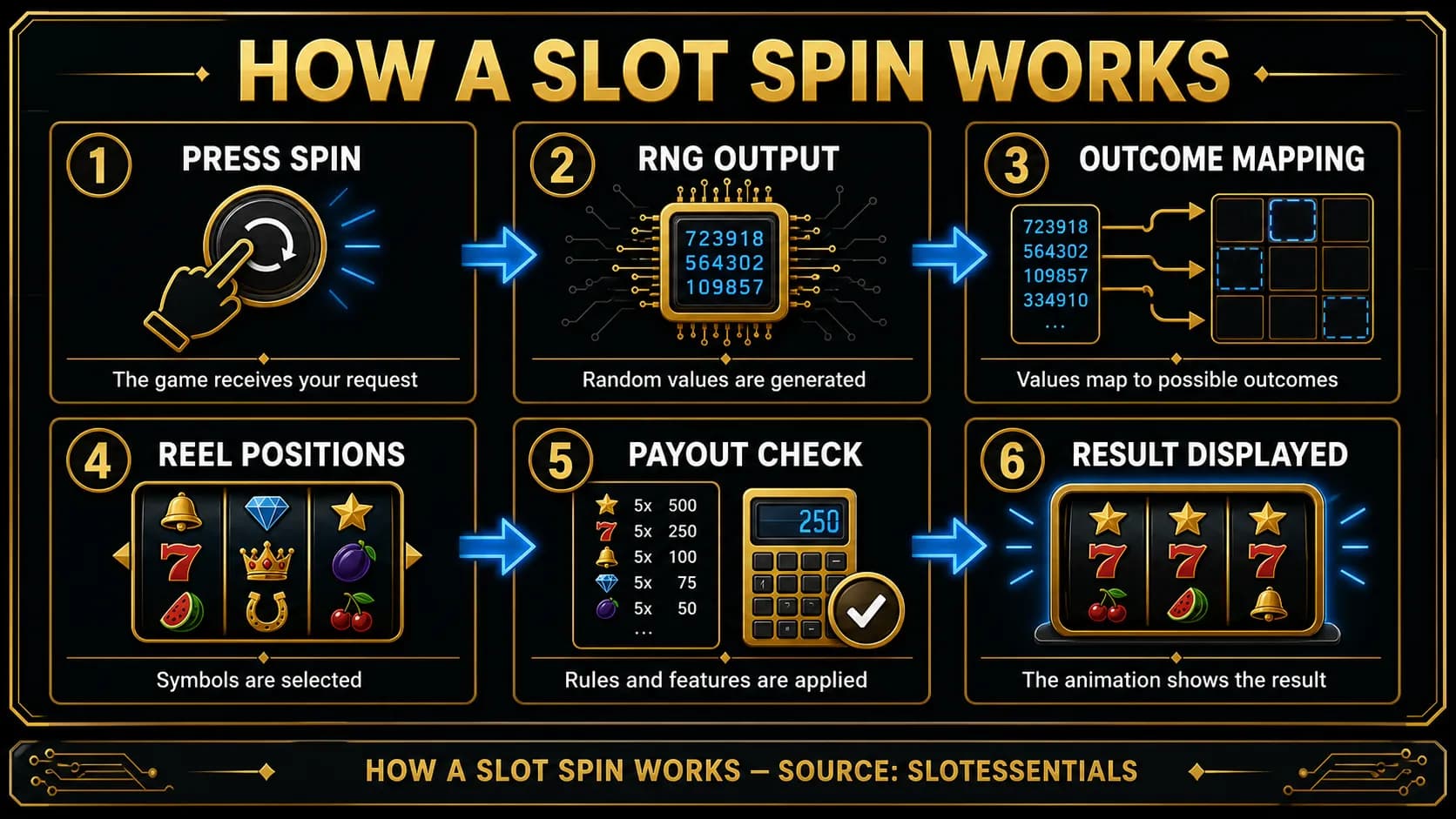
Source: SlotEssentials. You may share this infographic with attribution and a link to the SlotEssentials RNG guide.
When you press Spin, the software receives a request containing relevant information such as the selected stake and active game mode.
The system obtains one or more random values. Depending on the architecture, critical game logic may run on a remote gaming server rather than entirely in the browser animation.
Raw random numbers do not look like cherries, wilds or bonus scatters. The game maps them to virtual reel stops, symbol positions, weighted outcome tables or another structure defined by its rules.
The mathematical engine applies the paytable and mechanics. It determines whether the arrangement forms paylines, clusters, scatter wins, cascades, a bonus trigger or another event.
The game calculates the result according to the stake, paytable, multipliers and feature rules.
The reels animate and stop on the selected symbols. Sounds, celebrations and visual effects communicate the result.
In simplified form:
Press Spin → RNG output → outcome mapping → reel positions → paytable evaluation → displayed result
The animation is important to the entertainment experience, but it should not be confused with a physical reel gradually deciding where to stop.
Traditional-looking slots can use virtual reel strips containing symbol positions. A random value is mapped to a stop on each reel, producing the visible grid. Modern games may use more complex systems for variable rows, cluster grids, expanding layouts or feature states.
Not every symbol must have an equal probability. A common low-value symbol may occupy many virtual positions, while a jackpot symbol may occupy very few. The RNG selects randomly from the configured possibility space; the mathematical model determines how common each mapped outcome is.
This distinction is essential:
For more background on the visible structure, read what slot reels are and how they work and our guide to how paylines determine wins.
Randomness and theoretical RTP are not contradictory.
Imagine a simple game with a known collection of possible outcomes. Each outcome has a probability and a payout. When all probabilities and payouts are combined, they produce a theoretical expected return. The RNG randomly selects from that designed outcome space.
Over a very large number of trials, observed results may move toward the theoretical RTP. Over a short session, the actual return can be dramatically different because random samples vary.
A 96% theoretical RTP therefore does not mean every player receives 96% of a deposit. It means the game’s complete probability and payout model has that long-run expectation. Our guide to RTP in slots explains this distinction in depth.
The RNG selects outcomes, but the mathematical model controls their distribution.
A low-volatility game may map more of its probability space to frequent small payouts. A very-high-volatility game may concentrate more theoretical return in rare bonuses or large combinations. Both can use a properly random selection process.
Read Hit Frequency vs RTP vs Volatility for a direct comparison of the three statistics.
Bonus rounds can contain several layers of random selection.
The base-game spin may randomly produce the scatter or feature trigger. During the feature, further RNG calls may determine symbol positions, multipliers, wild locations, retriggers or prize selections. The exact sequence depends on the rules of the game.
Some features also include persistent state. A multiplier can increase, a meter can fill or a collected symbol can remain active. State changes the rules applied to later random selections; it does not necessarily remove randomness.
Always consult the game rules to understand:
Our guides to bonus-buy slots and feature-spin slots explain these formats from the player-facing side.
At a properly licensed and regulated operator, the game should operate according to its approved rules and configured mathematical version. A casino may be able to choose from RTP configurations made available by the developer, but that is different from manually changing the next result because a particular player is winning.
The UK Gambling Commission’s RNG standard states that adaptive behavior—intervention that changes the probability of outcomes during play—is not permitted for games subject to that requirement. Regulated software is also subject to testing processes. The Commission explains that operators submit game and RNG test information, while approved testing work can examine randomness, scaling and mapping. See its remote-games information requirements.
Regulatory standards differ by jurisdiction. Players should verify the operator’s current license on the regulator’s official register rather than relying only on a logo in a footer.
Demo play is useful for learning controls, symbols, features and game pace without staking money. However, players should not assume that a demo proves what a future paid session will do.
Depending on the operator, developer and jurisdiction, demo and real-money versions may be required to follow specific rules or may use different configurations. Verify the published information for the exact version you are using.
Even when both modes use identical mathematics, a small demo sample cannot establish the true RTP, hit frequency or bonus rate. Random variation can make one short test appear exceptionally generous and another exceptionally poor.
Use demo mode to understand the game—not to find a machine that appears “ready.” Our slot demo guide provides a practical checklist.
In regulated markets, testing can include review of the game’s mathematical behavior, RNG, mapping, rules, security or implementation. The specific process depends on the jurisdiction and product.
Testing does not mean every player will receive a smooth return. A fair high-volatility game can still produce harsh losing sequences. Testing is intended to assess whether the system operates according to required standards and its declared model—not to remove the house edge or guarantee individual outcomes.
When evaluating an operator, look for:
A standard random slot does not owe a player repayment after a losing run. Previous losses do not make the next independent outcome more favorable.
The previous win does not automatically reduce the probability of the next independent spin. The belief that an outcome must swing in the opposite direction is a version of the gambler’s fallacy.
Timing may correspond to a different random value, but a player cannot reliably know or control the internal RNG state. “Stop the reels” buttons typically change the animation speed rather than create a predictable mathematical advantage.
Changing the stake changes the amount wagered and potential cash payout. Unless the published rules explicitly describe a stake-dependent mechanic, it should not be assumed to make the feature due.
Human beings are excellent at seeing patterns—even in random data. A streak may be real as a description of the past while having no predictive power over the next result.
RTP belongs to the probability and payout model. The RNG’s job is unpredictable selection. A higher-RTP configuration offers better theoretical long-run value, but it does not deliberately reward a specific player.
Players cannot control the random result, but they can control several decisions around the session:
Use the SlotEssentials Slot Database to compare published game characteristics and the Session Tracker to record your own time and spending. Tracking is for awareness and organization, not prediction.
Properly regulated online slots use RNG systems intended to produce unpredictable outcomes according to approved rules. The exact technical standard and testing process depend on the jurisdiction.
Implementations differ. Many explanations describe continuously changing internal states, but players should not assume every provider uses an identical architecture. What matters is that the selected result meets the applicable randomness and game rules.
In software slots, the displayed reel animation generally communicates an outcome already selected and evaluated by the game system. The spinning animation is not equivalent to physical reels gradually choosing a result.
At a compliant regulated operator, RNG output should be unpredictable and game results should follow the approved system. The applicable regulator and testing documentation are the best sources for the jurisdiction’s requirements.
No reliable strategy can predict an independent RNG result from a short history of previous spins.
The implementation varies. A bonus buy may enter a different game state or feature with its own rules and outcome selections. Check the game documentation rather than assuming all games work identically.
Any untrusted software creates risk, which is why licensing, technical standards and independent testing matter. Avoid unlicensed operators and verify licenses using official regulator records.
The RNG supplies unpredictable values. The slot’s mathematical model maps those values to symbols, features and payouts. Together they allow individual spins to be random while the complete game retains a designed RTP, hit frequency and volatility profile.
Understanding that system is useful because it removes false expectations. A losing streak does not make a bonus due. A recent max win does not make a game empty. Timing tricks and pattern systems do not overturn the mathematics.
Compare game information using the SlotEssentials Slot Database, learn mechanics in demo mode and keep firm time and money limits whenever real money is involved.
