Open almost any online slot information page and you will see a collection of numbers: RTP, volatility, maximum win and, occasionally, hit frequency. They look as though they should tell you whether a game is likely to perform well. In reality, each statistic answers a different question—and none predicts the result of your next spin.
RTP describes the game’s theoretical return over an extremely large number of wagers. Hit frequency estimates how often a spin produces a win of any size. Volatility describes how widely the size and timing of payouts can vary. Understanding the difference helps you choose games that fit the type of experience you want, while keeping realistic expectations about the role of chance.
This guide explains all three statistics, how they interact and how to compare them using the SlotEssentials Slot Database.
Important: Slot statistics describe a game’s mathematical design. They do not provide a winning system, identify when a game is “due,” or make gambling profitable. Every session can end in a loss. Only gamble if it is legal where you live, and only with money you can afford to lose.
| Statistic | What it measures | What it can tell you | What it cannot tell you |
|---|---|---|---|
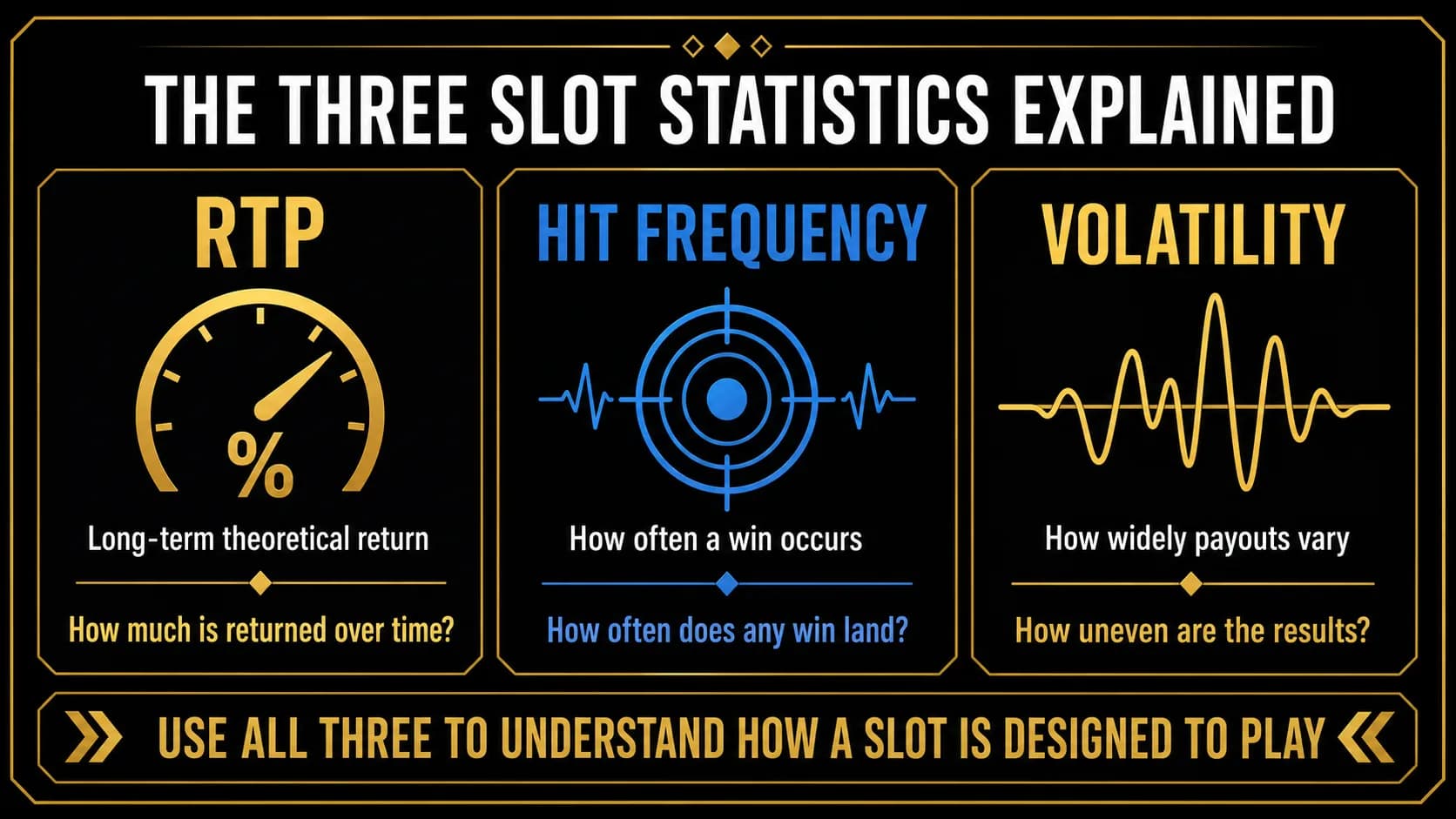
The easiest way to remember the distinction is:
Two slots can share the same RTP and still feel completely different because their hit frequencies and payout distributions differ.
RTP stands for Return to Player. It is expressed as a percentage and represents the theoretical portion of total wagers that a game returns across a very large sample of play.
If a slot has a theoretical RTP of 96%, its mathematical model is designed to return £96 for every £100 wagered in aggregate over the long run. The remaining 4% is the theoretical house edge.
That does not mean that depositing £100 should leave you with £96. RTP is not a cashback rate, a session promise or a forecast. The calculation may require millions or billions of simulated spins to stabilize near its theoretical value. A short session can finish far above or far below it.
For a deeper explanation of the calculation and its limitations, read our complete guide to slot RTP.
Developers sometimes release several approved configurations of the same title. An operator may offer a version at 96%, while another uses a lower permitted configuration. Bonus-buy modes can also have a different theoretical RTP from the base game.
Always check the information or paytable inside the version you are actually playing. Do not assume that a number from a review applies to every casino or every game mode.
Hit frequency—also called hit rate—is the theoretical proportion of spins that produce a qualifying win.
If a game has a published hit frequency of 25%, that broadly means one in four spins is expected to produce a win across a sufficiently large sample. It does not mean every fourth spin will win. Random results can produce several wins close together or long sequences without one.
The word win also needs context. A spin can be recorded as a win even when the payout is smaller than the wager. If you stake £1 and receive £0.40, the game may celebrate the result with sounds and animation, but your balance has still decreased by £0.60.
That is why hit frequency should never be treated as a profitability percentage.
Imagine two theoretical games:
Game A may feel busy and active. Game B may feel slow and punishing until a meaningful feature appears. Either game could have the same 96% RTP.
Often, but not always.
A high hit frequency commonly appears in lower-volatility games because frequent small wins smooth the balance. However, hit frequency measures only how often wins occur. It does not measure their range or size. A game can combine frequent small wins with extremely rare large wins and still have substantial volatility.
Treat hit frequency as one part of the payout profile, not a replacement for volatility.
Volatility—often called variance in casual slot discussions—describes how widely results can swing around the game’s expected return.
Low-volatility games generally distribute more of their return through frequent, smaller payouts. They can provide longer stretches of activity and may reduce the speed of balance swings, although losses remain possible and the house edge still applies.
They may suit players who prefer:
Medium-volatility games try to balance regular wins with occasional larger features. The label is broad and can vary between developers, so it should be treated as a general description rather than an exact standardized measurement.
High-volatility games concentrate more of their theoretical return in less frequent, larger outcomes. They can produce long dry periods, bonus rounds that return very little and sudden large swings.
They may appeal to players who value large multiplier potential, but they also carry a higher risk of exhausting a fixed session budget quickly.
Our guide to how slot volatility affects your wins and sessions explores these categories in more detail.
No single statistic provides a complete picture. Consider three hypothetical games, each with a 96% RTP:
| Game profile | RTP | Hit frequency | Volatility | Likely experience |
|---|---:|---:|---|---|
The theoretical long-run return is identical. The journey is not.
This is why asking “Which game has the highest RTP?” is only the beginning. A more useful question is: Which combination of RTP, hit frequency and volatility matches the experience and risk level I am prepared for?
The answer depends on what you are trying to understand.
If everything else is equal, a higher RTP means a lower theoretical house edge. A 96.5% configuration is mathematically preferable to a 94% configuration over a very large number of wagers.
But everything else is rarely equal. A small RTP difference will not protect a short session from volatility.
Hit frequency helps explain why some games constantly flash small wins while others appear quiet. It is useful for understanding rhythm, but not value by itself.
Volatility is often the most noticeable statistic during actual play. A very-high-volatility slot can consume a fixed budget quickly even with a competitive RTP. Players deciding whether a game fits their risk tolerance should pay close attention to it.
The strongest evaluation combines:
You can compare available game information in the SlotEssentials Slot Database before choosing a title.
Not necessarily. It pays more often, according to its theoretical model. Many of those wins may be smaller than the original stake.
No. RTP is a long-run average calculated across a huge sample. One session can be far below the theoretical percentage.
No. A sequence of losses does not create a debt that the game must repay. Assuming that a win becomes more likely after previous losses is the gambler’s fallacy.
Historical data describes what has already happened. It cannot make an independent random outcome predictable. Our analysis of daily versus weekly RTP trends explains when aggregated information is descriptive and when players risk reading too much into it.
Maximum win shows the payout ceiling, not the probability of reaching it. Two games advertising 10,000x can have very different mathematical paths and probabilities.
Check the in-game rules or information screen at the operator you use. Record the base-game and bonus-buy figures separately when both are published.
Do not treat “very high” volatility as a promise of a large payout. It is primarily a warning that outcomes can be widely dispersed and dry spells can be severe.
Ask what qualifies as a hit. Unless the source explains its methodology, avoid assuming that every recorded hit produces a net gain.
Demo play can help you learn paylines, features and controls without wagering. It does not reveal what will happen in a future real-money session. Read how to test slots in demo mode before drawing conclusions from a small sample.
The SlotEssentials Session Tracker can help you record time played, starting and ending balances, total wagered and net results. Use the history to understand your own spending and session patterns—not to identify a “hot” game or forecast the next spin.
Many modern online slots publish theoretical RTPs around 96%, but available configurations vary. A higher percentage means a lower theoretical house edge when all other factors are equal. It does not guarantee a better individual session.
It means the game is theoretically designed to produce a qualifying win on roughly 30% of spins over a sufficiently large sample. Whether that feels “good” depends on the size of those wins, volatility and personal preference.
The theoretical hit frequency belongs to the game’s mathematical configuration. Your observed hit rate can vary dramatically during a short session because random samples fluctuate.
No. RTP and volatility measure different characteristics. A high- and low-volatility slot can share the same theoretical RTP.
Neither is universally better. High RTP improves theoretical long-run value, while lower volatility generally reduces the size of short-term swings. The appropriate combination depends on the experience you want and the risk you accept.
They can help you understand and compare games, but they cannot overcome the house edge or predict random outcomes.
RTP, hit frequency and volatility are complementary—not competing—statistics. RTP describes theoretical long-run return. Hit frequency describes how often wins occur. Volatility describes how unevenly payouts are distributed.
Use all three to understand what a game is designed to feel like. Verify information in the exact game version, recognize that short sessions can differ enormously from theoretical averages, and never treat descriptive data as a prediction.
Explore the SlotEssentials Slot Database to compare games, or use Session Tracking to maintain a clearer record of your own play.
18+ only. Gambling involves risk and can cause harm. Set firm time and money limits, never chase losses, and seek support if gambling stops feeling manageable.
