You've just wrapped up a 25-slot bonus hunt. You remember the Gates of Olympus hit something decent, Fruit Party was a disaster, and one of the Sweet Bonanza bonuses did something — but you can't quite recall the number. You close the session with a rough idea of whether you're up or down, but the details are already fading.
Most slot players — even experienced ones — track their sessions in their head, or not at all. It feels fine in the moment. But over weeks and months, the gaps in your memory add up to a distorted picture of your play. Wins stay vivid. Losses blur. And without real numbers, you can't make real decisions.
We'll cover exactly what to track in every bonus hunt, how to do it properly, why a dedicated tracker beats a spreadsheet, and how to get set up in under 10 minutes using a free tool built specifically for this. If you're a streamer, there's a section for you too — because good tracking isn't just about your bankroll, it's about your content.
If you're already deep in the slot world, skip ahead. But for anyone finding this guide through search — here's the short version.
A bonus hunt is a session format where you collect or buy bonus rounds across a range of slots without opening them immediately. Once you've built up a collection — usually anywhere from 10 to 50+ bonuses — you open them all in one go and watch the results pile up.
Players and streamers love the format for a few reasons. The "opening" phase is high energy and easy to watch. Collecting across a wide range of slots smooths out some of the variance you'd get from hammering one game. And the final tally — total spent vs total returned — gives you a clean, satisfying number to end on.
That final number is also exactly why tracking matters. To know whether a bonus hunt was profitable, you need to know what every single bonus cost and what every single bonus paid. No rounding. No "I think that one was about £8." Exact numbers.
Beyond just knowing if you won or lost, consistent tracking gives you something more valuable over time: data you can actually use.
The most obvious benefit. When you track every session, you know your real position — not the version your memory has edited. Players who don't track almost always overestimate their wins and underestimate their losses. It's not dishonesty, it's just how memory works. Emotion sticks. Numbers fade. Tracking gives you the numbers.
After 20 or 30 sessions, your data starts to tell a story. Maybe Sweet Bonanza consistently underperforms your expectations at a certain stake. Maybe Pragmatic Play bonus buys are delivering better average multipliers than Hacksaw for you. You can't see these patterns from memory — but you can see them from a spreadsheet or dashboard.
If you stream, your audience watches your results. Streamers who display accurate, real-time stats — total spent, total returned, best hit of the session — build trust in a way that gut-feel commentary simply can't. Viewers can see exactly what's happening. That transparency is a big part of why some channels grow and others plateau.
There's a specific kind of bad decision that happens mid-session when you've lost track of your numbers. You're not sure how much you're down, so you make a rough estimate, and that estimate is usually optimistic. Then you keep going. Then you're actually very far down, and by then you've already committed emotionally to recovering.
Tracking breaks this cycle. When you can see the real number at any point in the session, you can make a rational decision about whether to continue — rather than an emotional one.
Slots are high-variance by design. Short-term results, good or bad, don't tell you much about the underlying quality of a game. Tracking over the long term gives you a much more honest view of your actual return — and helps you hold your nerve through a cold stretch without abandoning games that are still fundamentally sound.
The more you log, the more useful your data becomes. At minimum, you want to capture the essentials. Here's a complete field guide:
| Field | Why It Matters | Example |
Bonus cost should be the actual stake you bought or collected the bonus at — not the stake you'd normally play at. If you bought a bonus at £2 and your usual stake is £1, log £2.
Multiplier is worth tracking separately from profit/loss because it normalises for stake size. A £50 win from a £2 bonus (25x) is a better result than a £50 win from a £10 bonus (5x), even though the cash amount is the same.
Notes are underrated. A single line like "bought feature, triggered again during base" or "4 scatters, no multipliers" gives you context you'll appreciate when you're reviewing old sessions months later.
Provider might feel unnecessary, but if you track 200+ bonuses and then filter by provider, you'll quickly see which studios are performing for you and which aren't. That's a genuinely useful filter that most players never have access to.
The honest answer: both work, but they're right for different situations.
Spreadsheets are free, flexible, and require zero sign-up. If you know your way around a formula, you can build something reasonably powerful. A lot of serious bonus hunters have been running custom Google Sheets for years and are happy with them.
The other advantage is full control. You can add any field you want, structure it exactly the way your brain works, and change it whenever you like.
The main problems are friction and features.
Friction: Logging each bonus into a spreadsheet manually, mid-session, with real stakes involved, is slower and more error-prone than using a tool built for the purpose. The more tedious it is, the more likely you are to miss entries or approximate numbers.
No live sharing: If you're streaming, a spreadsheet sitting on your second monitor isn't something your viewers can see or interact with. There's no live overlay, no community leaderboard, no way to display your running totals in real time.
No automatic stats: You can build formulas that calculate profit/loss and average multiplier — but you have to build them, maintain them, and keep them working as your data grows. One broken formula can corrupt your historical data quietly for sessions before you notice.
No community: A spreadsheet is a solo tool. There's no way to compare your results to other players, see what's performing well on a leaderboard, or join a community built around the same activity.
A dedicated tracker solves all of these problems. The trade-off is that it requires a sign-up and you're working within the tool's structure rather than building your own.
For casual players who just want a quick record of sessions, a spreadsheet is fine. For anyone playing regularly, streaming, or wanting to build meaningful long-term data, a dedicated tracker is meaningfully better.
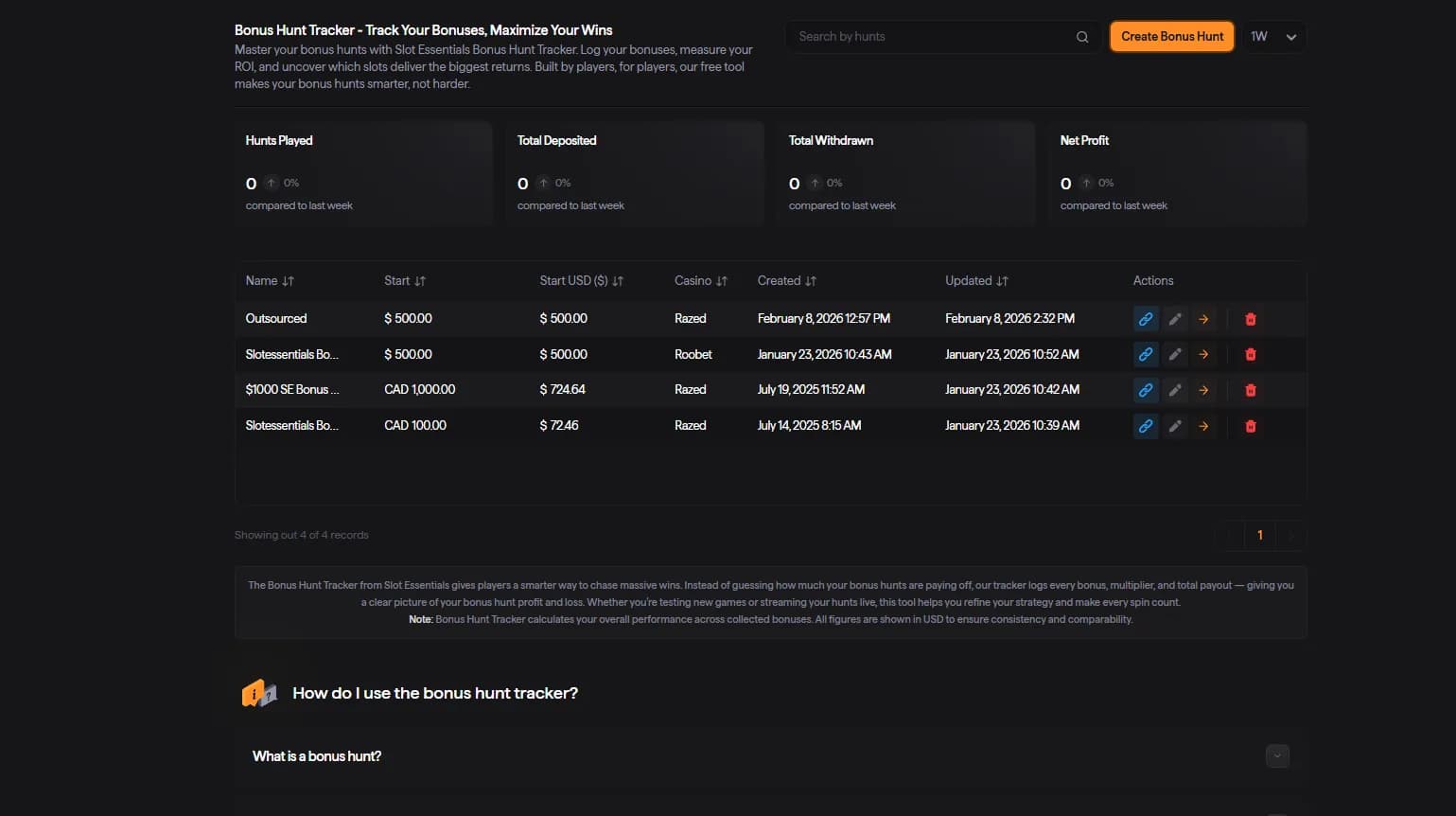
SlotEssentials is a free platform built specifically for slot players and streamers. The bonus hunt tracker is one of its core features — here's exactly how to use it.
Head to SlotEssentials.com and sign up. No payment required. The whole platform is free.
Once you're logged in, find the Bonus Hunt Tracker from the main navigation. This is your dedicated space for logging hunts — separate from session tracking, the slot database, and other features.
Click to start a new hunt. Give it a name if you want (helpful when you're reviewing old sessions), and set your starting balance. This gives you a clean baseline for the session.
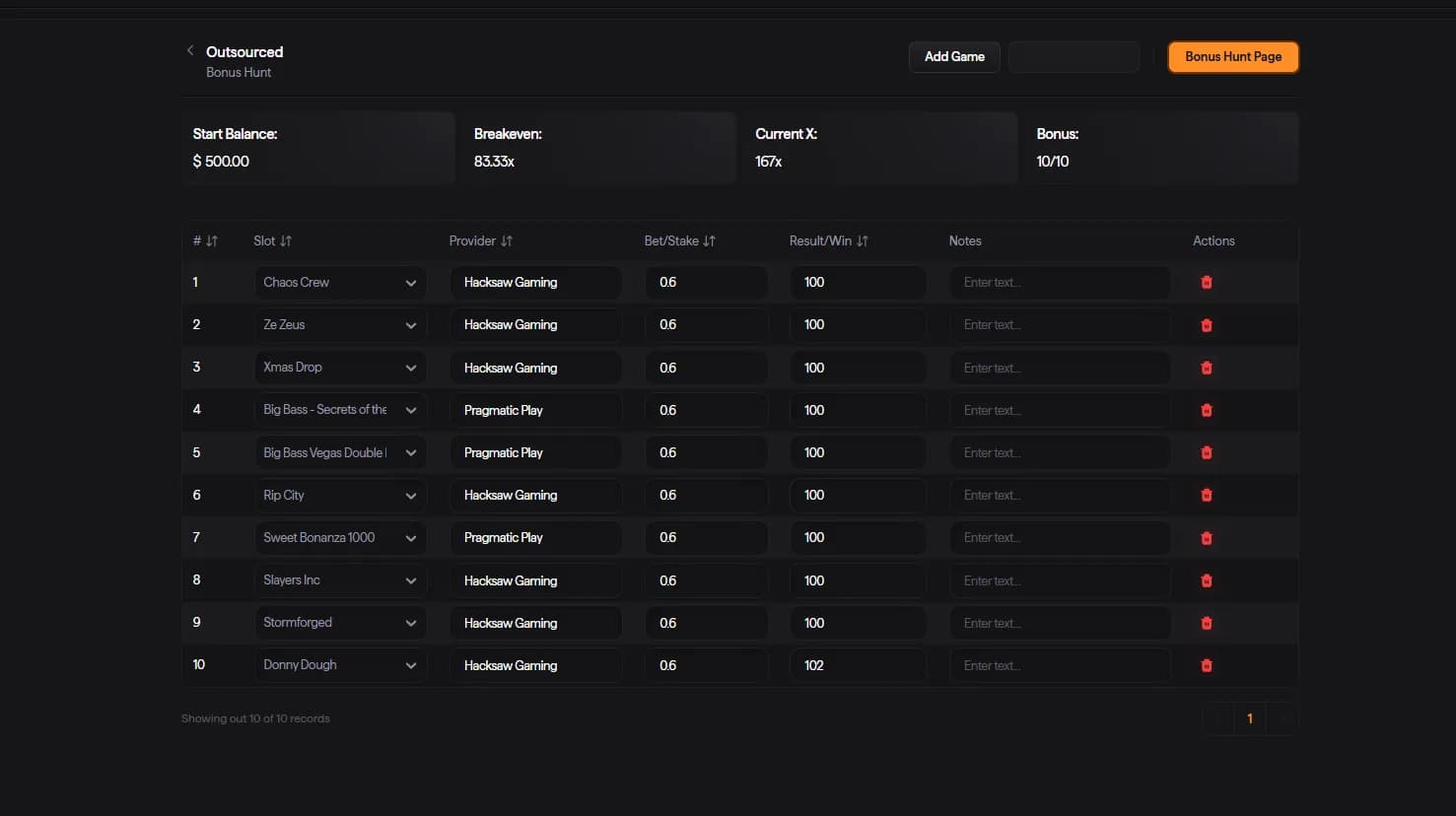
For each bonus you collect or buy, log the slot name, the cost, and the provider. You can do this as you go — it takes a few seconds per entry. The tracker keeps a running total of your collection as it grows.
When you start the opening phase, enter the result for each bonus as you open it. The tracker automatically calculates the profit/loss and multiplier for that bonus in real time.
Once all bonuses are opened, your session summary is instantly available: total spent, total returned, overall profit/loss, average multiplier, best-performing slot, and worst-performing slot.
For streamers: Before you start your session, set up the SlotEssentials stream widget. This displays your live bonus hunt progress directly on your stream overlay — viewers can see your running totals, current best hit, and session profit/loss in real time. It takes about 10 minutes to set up and adds a layer of engagement that viewers genuinely respond to.
Having data is one thing. Using it well is another. Here are a few habits that make your tracking genuinely valuable over time.
One bad session doesn't tell you anything meaningful about a slot. One cold month might be variance. But if you're reviewing your data monthly and a particular game is consistently underperforming your average across 30+ bonuses, that's a real signal worth acting on.
Get into the habit of a quick monthly review. Look at your total profit/loss, your average multiplier, and your best and worst performing games. Fifteen minutes of honest review once a month is worth more than hours of gut-feel analysis during sessions.
Individual slots have a lot of variance. Filtering by provider gives you a broader, more stable view. If you've played 80 Pragmatic Play bonuses and 60 Hacksaw bonuses and there's a consistent difference in your average multiplier, that's the kind of insight that can genuinely influence where you spend your budget.
This sounds basic, but it's worth saying: decide your maximum spend before the session starts, not during it. Log it in your notes when you open the session. Committing to a number before the emotional heat of a live session is always going to produce better decisions than trying to make that call mid-hunt.
You'll have cold sessions. You'll have sessions where nothing hits. When that happens, your historical data is genuinely useful — not for comfort, but for perspective. If your 6-month average multiplier is 8x and this session delivered 3x, that's variance doing what variance does. The data tells you that. Your memory and emotions in the moment won't.
The most trusted streamers in the slot space are the ones who show the full picture — not just the hits. Sharing your session summary after a stream (total spent, total returned, best hit) builds a level of credibility that curated highlight content simply can't match. Your audience isn't just watching for the wins. They're watching because they trust you to be honest about what's actually happening.
SlotEssentials offers a free bonus hunt tracker that handles all the logging and calculations automatically, includes live stream widgets for overlay display, and connects to a wider platform with session tracking, a slot database, and community leaderboards. It requires a free sign-up and works on desktop and mobile.
At minimum: slot name, bonus cost, and result. For deeper analysis, also track the provider, multiplier, session date, and any notes about how the bonus played out. The more consistently you log, the more useful your data becomes over time.
SlotEssentials includes a stream overlay widget that displays your live session stats directly on your Twitch or Kick stream. It shows your running total, profit/loss, and best hit in real time. Viewers can follow along without you having to manually narrate every number.
Yes. The value of tracking comes from volume, not from any single session. A 5-bonus hunt feels too small to bother logging, but 50 of those sessions gives you 250 data points that paint a clear picture of your actual performance. Start tracking everything from day one.
Look at average multiplier across at least 20–30 bonuses from that game. A single big hit can distort a small sample. Over 30+ bonuses, your average multiplier gives you a reasonable read on how the game is performing for you relative to its theoretical RTP.
Yes. SlotEssentials works on mobile, which is useful if you want to log bonuses on a separate device while playing on your main screen.
Tracking your bonus hunts won't change the variance of the games you're playing. Nothing will. But it will give you something that most players never have: an honest, accurate picture of your own play.
That picture helps you make better decisions — about which games to priorities, how to manage your bankroll, when a cold streak is just variance and when it's a genuine pattern. And if you're streaming, it gives your audience a level of transparency that builds real, lasting trust. The tool is free. The set-up takes ten minutes. And the data you start collecting today will be genuinely useful six months from now.
Free sign-up. No payment required. Bonus hunt tracker, session stats, live stream widgets, leaderboards, and more — all in one place.
